


Market Outlook 2027: A year powered by earnings
As 2026 draws to a close, we leave behind a year that began with the prospect of a particularly favourable environment for economies and financial markets, but was soon confronted with an unexpected conflict and an energy shock that continues to shape the global landscape. Once again, the global economy has been tested. And once again, it has demonstrated a remarkable capacity to absorb the shock and continue expanding.
This resilience provides the starting point for our 2027 outlook. The investment environment has undoubtedly become more complex: geopolitical fragmentation, fiscal concerns and higher long-term interest rates are no longer temporary disruptions, but increasingly structural features of the global landscape. Yet the foundations of the expansion remain in place, supported by two powerful and complementary engines: the AI investment cycle and a traditional economic cycle sustained by consumption and business investment.
This combination creates a constructive, but increasingly selective, environment for investors. Earnings remain at the heart of our investment thesis, while higher yields provide an attractive source of recurring income across fixed income markets. Against this backdrop, we identify three major investment ideas for 2027: developed-market equities supported by earnings growth, fixed income with carry at its core, and commodities as a source of portfolio diversification.
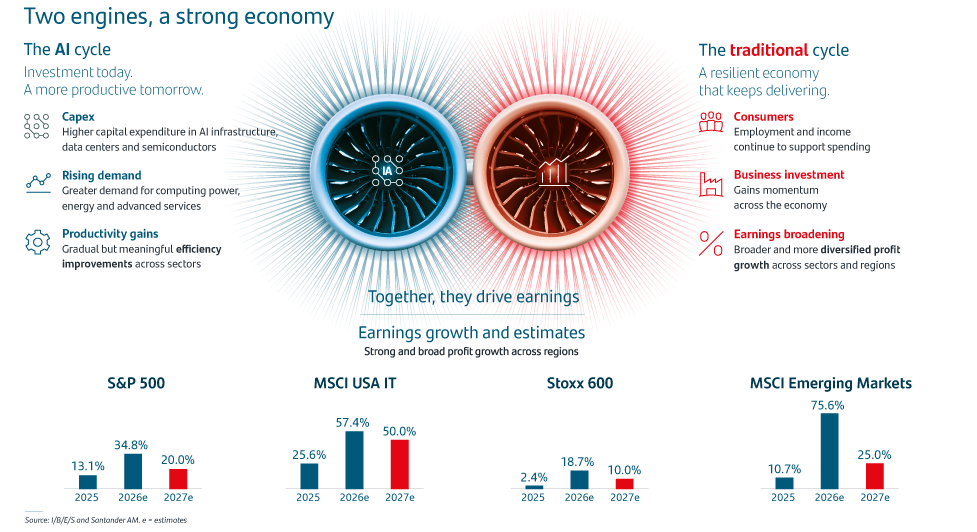
1. Developed-market equities: A year powered by earnings
Developed-market equities remain at the core of our strategy for 2027. Our conviction rests increasingly on earnings rather than on further multiple expansion. A resilient economic cycle continues to support revenues and margins, while the AI investment cycle provides an additional source of growth through capital expenditure, rising demand for computing power and, gradually, productivity gains. At the same time, the traditional cycle remains supportive, allowing earnings growth to broaden beyond technology and across sectors and regions.
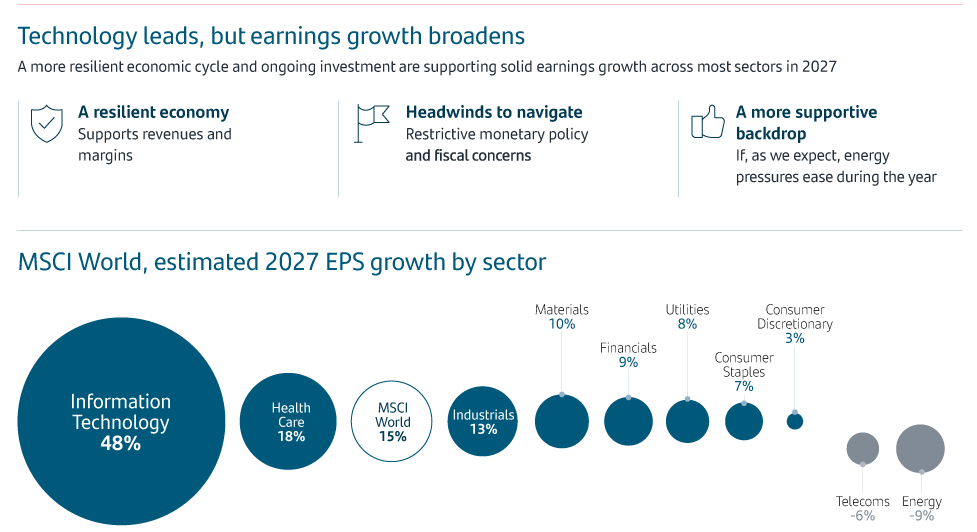
This broadening is central to our investment thesis. In the U.S., we expect strong corporate earnings to remain the key market driver, with earnings growth continuing to broaden beyond technology as the benefits of investment and economic resilience reach a wider set of companies. In the Eurozone, stronger domestic demand and fiscal stimulus —with Germany as an important catalyst— provide a more supportive backdrop for corporate profits. Across developed markets, we therefore favour high-quality companies with solid balance sheets, strong cash generation and the ability to translate investment and nominal growth into sustainable earnings. This emphasis on quality is particularly important while markets continue to navigate persistent headwinds, from elevated energy prices to restrictive monetary conditions and fiscal uncertainty. Companies with stronger fundamentals should be better positioned to absorb these pressures until the backdrop becomes more supportive, particularly if, as we expect, energy pressures ease during the year.
2. Fixed income: Carry takes the lead
Higher interest rates have fundamentally changed the opportunity set in fixed income. In 2027, investors do not need to rely on aggressive monetary easing or large declines in bond yields to generate attractive returns: current yield levels already provide a meaningful source of recurring income. Our starting point for 2027 is clear: carry comes first. Resilient growth, persistent fiscal concerns and structurally higher term premia are likely to keep long-term rates elevated.
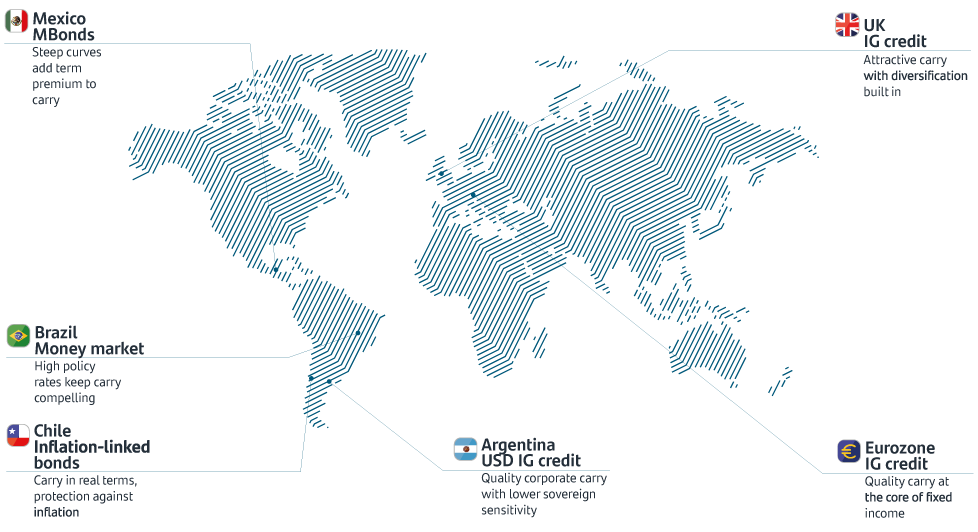
Duration may become an additional source of return as the year progresses, particularly if inflationary pressures moderate and central banks gain room to adopt a less restrictive stance. Until then, the opportunity lies in identifying where carry is most attractive across fixed income markets. Depending on each economy’s position in the economic and monetary cycle, the shape of its yield curve and the specific characteristics of its market, different segments of fixed income can offer particularly compelling opportunities —from money markets and sovereign bonds to high-quality corporate credit. This allows us to capture attractive carry across geographies while remaining selective on duration and credit risk, and retaining the flexibility to add duration when the macroeconomic environment becomes more supportive.
3. Commodities: Supported by the global investment cycle
Commodities are our third major investment theme for 2027, supported by a global investment cycle that is becoming increasingly resource-intensive. Infrastructure spending, electrification, AI-related investment and higher spending on defence and energy security should sustain demand for energy and raw materials, providing a structural source of support for the asset class. The investment cycle is also creating opportunities beyond commodities themselves: in Chile, attractive valuations and a renewed push to unlock investment projects, together with a recovery in economic activity and earnings, support our constructive view on the local equity market.
At the same time, commodities offer a valuable source of portfolio diversification. In a world characterised by greater geopolitical fragmentation, a stronger focus on security of supply and continued uncertainty around inflation, their distinct sensitivity to real-economy and supply-side developments can complement traditional equity and fixed income exposures. Together, these factors support a constructive view across commodities. However, opportunities are likely to vary across commodity segments, reinforcing the importance of selectivity, as we discuss in more detail later in this Outlook.
Our CMAs point to higher returns over the next seven years
These three key investment ideas reflect the combination of our global and local capabilities and are supported by our proprietary CMAs framework — an approach that allows us to integrate traditional and private markets in a single analytical model. This year’s estimates point to higher expected returns across asset classes compared with a year ago, improving the opportunity set for investors over our seven-year investment horizon.
What will 2027 bring?
Discover our key messages and possible investment strategies to follow.

This report has been prepared by Santander Asset Management (hereinafter “SAM”). SAM is the functional name of the asset management business conducted by the legal entity SAM Investment Holdings S.L. and its branches, subsidiaries and representative offices. This document contains economic forecasts and information gathered from several sources. The information contained in this document may have also been gathered from third parties. All these sources are believed to be reliable, although the accuracy, completeness or update of this information is not guaranteed, either implicitly or explicitly, and is subject to change without notice. Any opinions included in this document may not be considered as irrefutable and could differ or be, in any way, inconsistent or contrary to opinions expressed, either verbally or in writing, advices, or investment decisions taken by other areas of SAM. This report is not intended to be and should not be construed in relation to a specific investment objective. This report is published solely for informational purposes. This report does not constitute an investment advice, an offer or solicitation to purchase or sell assets, services, financial contracts or other type of contracts, or other investment products of any type (collectively, the “Financial Assets”), and should not be relied upon as the sole basis for evaluating or assessing Financial Assets. Likewise, the distribution of this report to a client, or to a third party, should not be regarded as a provision or an offer of investment advisory services. SAM makes no warranty in connection with any market forecasts or opinions, or with the Financial Assets mentioned in this report, including with regard to their current or future performance. The past or present performance of any markets or Financial Assets may not be an indicator of such markets or Financial Assets future performance. The Financial Assets described in this report may not be eligible for sale or distribution in certain jurisdictions or to certain categories or types of investors. Except as otherwise expressly provided for in the legal documents of a specific Financial Assets, the Investment Products are not, and will not be, insured or guaranteed by any governmental entity, including the Federal Deposit Insurance Corporation. They are not an obligation of, or guaranteed by, Santander, and may be subject to investment risks including, but not limited to, market and currency exchange risks, credit risk, issuer and counterparty risk, liquidity risk, and possible loss of the principal invested. In connection with the Financial Advisors, investors are recommended to consult their financial, legal, tax and other advisers as such investors deem necessary to determine whether the Financial Assets are suitable based on such investors particular circumstances and financial situation. Santander, their respective directors, officers, attorneys, employees or agents assume no liability of any type for any loss or damage relating to or arising out of the use or reliance of all or any part of this report. Past performance does not predict future returns. The returns may increase or decrease as a result of currency fluctuations relative to the respective investors’ domestic currency. Any reference to taxation should be understood as depending on the personal circumstances of each investor and which may change in the future. Costs incurred for purchasing, holding or selling Financial Assets may reduce returns and are not reflected in this report. This report may not be reproduced in whole or in part, or further distributed, published or referred to in any manner whatsoever to any person, nor may the information or opinions contained therein be referred to without, in each case, the prior written consent of SAM. Any third-party material (including logos, and trademarks), whether literary (articles/ studies/ reports, etc. or excerpts thereof) or artistic (photos/graphs/drawings, etc.), included in this report is registered in the name of its respective owner and only reproduced in accordance with honest industry and commercial practices.